Archive for year 2010

TTT: The NWP Digital Is Site

A few weeks ago, I had the good fortune of being invited onto Teachers Teaching Teachers webcast to talk about the official launch of the National Writing Project’s Digital Is website, which is home to many interesting projects that push the possibilities of technology and learning. I have contributed some content and added some conversations to the Digital Is site (you should, too!)

Here is the TTT podcast from the TTT site. Thanks to Paul Allison and Susan Ettenheim for continuing to create interesting weekly discussions around topics that have value for me as a teacher.

Peace (in the discussions),
Kevin

More with Cinchcast: poetry podcasting

The more I use Cinchcast, the more I like it. This morning, I was writing some poems and thought I might try to podcast them. I was considering using my phone and Cinchcast, but then I remembered a red “record now” button at the site. I figured I would give it a try with my Blue Snowball microphone and it worked like a charm.

And I can embed the audio, or download it. And my Cinch site is connected to Twitter. And it’s free.

The poems I wrote:

Dog Days
Today, I figure, is the day
our dog is one day older than
our son.
Tomorrow, it will be
seven days.
Next week? A month or maybe two.
The wet muzzle and playful eyes gaze
up at me as if to say,
your time will come, too, old man …
as he grows older right before my eyes
and then bounds off into the woods.

I’m Not That Poet
I find it particularly difficult
to be one of those
poets
whose eyes see every … little …moment
like a time-lapse camera.
They stand in front of the larger-than-life mural
and notice the face of the one lonely
boy in the back or they pay attention to
the joyful girl with flowers on her dress.
Me?
I notice the tacks on the corners of the canvas and wonder
why the whole thing doesn’t just tumble right down to the Earth,
spilling out humanity on the ground.
I’d be ready to stuff that boy
and that girl
and all the rest of those people right into my pocket
so that I could carry them around with me
like history etched beneath our skin.
That’s the kind of poet
I am.

Peace (in the poems),
Kevin


The Imaginary World of Musical Island

musical island
After Thanksgiving break, my students will be handing in their Imaginary Peaceful Land Travel Brochures. They’ve had plenty of class time to work on the project, and there are some pretty neat lands out there.  I had created my own, too, to share with them. I used Glogster and I think the future, I might have it as an option for my students, too. But I do like having them use cardstock paper for a brochure — that feels right. But with Glogster, they could add audio and video, etc.

Anyway, here is your invitation to Musical Island:

Peace (in the

Book Review: What Technology Wants

What Technology Wants - Kevin Kelly

I finished What Technology Wants a few weeks ago and I am still trying to sort out all that writer Kevin Kelly postulates in this interesting book which takes a step back from technology and tries to articulate a larger understanding of the world around us and the future ahead of us. What technology wants, according to Kelly, is a symbiotic relationship of sorts, with us, in that we keep developing new ways of using technology as technology advances in order to provide us with new ways of using technology.

That’s the simplified version, in my own words, and Kelly makes it clear that technology– or the technium, as he refers to the “greater, global, massively interconnected system of technology vibrating around us (p.11).” — is not alive in a living, breathing sense. But by examining trends of technological advancements, in relationship to advancements in other biological fields, Kelly argues that there is a logical and somewhat predictable pattern to technology, even though we don’t know what is coming next or how that will affect us. Like living creatures that push forward over time, the technium is also on the same course, according to Kelly. In fact, one of the hallmarks of the technium is that new devices or tools that have significant impact on our lives are hardly ever used for what they were designed for. This unknown adaptability is key to the technium.

Kelly writes, “The technium gains its immense power not only from its scale but from its self-amplifying nature. One breakthrough invention, such as the alphabet, the steam pump, or electricity, can lead to further breakthrough inventions, such as books, coal mines and telephones. These advances in turn led to other breakthrough inventions, such as libraries, power generators and the internet. Each step adds further powers while retaining most of the virtues of the previous inventions (p. 38).”

The meaning behind the phrase of  “what technology wants” is that it wants to keep moving forward, according to Kelly, by providing us humans with the tools for adapting technology for our own needs. There’s a certain circular pattern to this argument, which Kelly admits to. He cites Moore’s Law (of smaller, more powerful, technology) and other data models to show how the trends of technology is marching ahead on a mathematical curve. But, Kelly notes, this whole notion of technology being on par with biological trends is complicated — this idea of technology wanting something — and he sees three forces at work:

  • The concept of preordained development — that technology is designed to always improve itself and become more advances, and more ubiquitous;
  • The influence of technology’s history — that what has come before it is what shapes the present and lays the groundwork for the future
  • The free will of us, the people – our choices in how we use the technology is critical is what technology becomes.

Kelly does not always view technology through rose-colored glasses. In fact, he profiles a number of examples of how people can and should step back from technology in their lives, if only to gain some perspective on how it shaping what we do and how we think. He uses examples such as the Amish, who resist the lure of technology for cultural reasons and yet, they are adaptable to using what suits them (as long as it is mostly “off the grid” technology).There is a whole chapter about Amish Hackers that is interesting to read, and shows how complicated the lives of the Amish can be in the modern world. And, it shows how our (my) perception of the Amish stuck in time is not even remotely accurate.

In the more controversial section of the book, Kelly also showcases The Unibomber’s manifesto as an articulate examination of the ways that technology is influencing our lives and the reasons for resisting the technium by shaping its progress ourselves. Kelly condemns the violent nature of The Unibomber, of course, but he says that some of what Ted Kacyznski wrote makes sense in terms of retaining some of our humanity as technology’s influence in our lives takes hold and expands. Kelly acknowledges, and then refutes, this view that technology “robs us of our humanity and steals our children’s future (p. 213).”

Kelly ends on a positive note, arguing that our relationship with the technium opens up new possibilities for our lives and for our ability to be creative, and expressive. “The technium expands life’s fundamental traits, and in so doing it expands life’s fundamental goodness … Technology amplifies the mind’s urge towards the unity of all thought, it accelerates the connections among people, and it will populate the world with all conceivable ways of comprehending the infinite (p. 359).”

Is that a bit much? Perhaps. But Kelly has always looked ahead at the bigger picture (first with Whole Earth, and then with Wired, and now with his various books) and while I sometimes found myself shaking my head at what he was writing, I was always thinking, always pondering. What Technology Wants will sure get you to step back and reflect on where technology is and where it is going, even if the path is uncertain.

Peace (in the reflective thought),
Kevin

Lead Mines, Canals and Crashes: Digging into Local History

Soho History (2)
I’ve written before about my co-teacher, and here is another example of how his ideas and my ideas play off each other so nicely. We’re reading Regarding the Fountain by Kate Klise with our co-taught class right now. The plot has to do with a fifth grade class doing research on the local history of their town, and uncovering a plot of fishy intrigue.

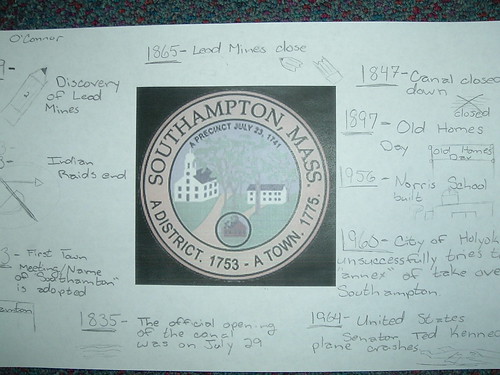
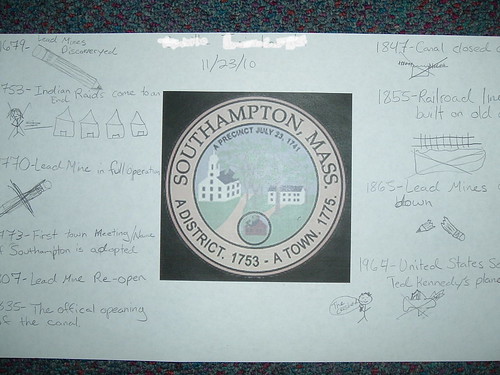
Bob, my co-teacher, thought we should do some research on our own town and then let the kids build a timeline of sorts of local historical episodes. Of course! So, I dug around the town’s website for some information, and Bob found a book that was published in the 1970′s by the town’s Historical Commission. We cobbled together a small packet of information, created a timeline that was missing either dates or information, and then had then work in teams to fill in the timeline. From there, they had to then create a placemat of the history of the town, organized in any way they wanted.
Soho History
Not only were the kids interested in the history of the community, they were fully engaged in all steps of the project, which took about thirty minutes. It was just one of the lessons that comes together collaboratively, and sparks something in the students that is just wonderful to watch. They were learning about history, using information reading for a realistic goal, creating timelines of information and collaborating together. That’s a nice bit of learning going on.  Not every lesson is like that, that’s for sure. But this one was.

Here are few things they didn’t know about their town but now do:

  • The town became a town because of a Lead Mine operation;
  • The New Haven-Northampton Canal ran right through the town, and when that shut down, the railroad followed. Now that is shut down, and the hope is for a bike trail (which is controversial in the town);
  • Sen. Ted Kennedy was once hurt in a plane crash (and the pilot died) in some fields not too far from the school;
  • The movie “Whose Afraid of Virginia Woolf?” (with Richard Burton) shot some scenes in a local restaurant in town;
  • An adjacent city tried to annex the town in the 1960s but failed when the town used its political might to fend off the plot (which led to cheers from the students when we talked about it).

Peace (in the discovery),
Kevin

Give Thanks with Day in a Sentence

dayinsentenceiconBonnie is hosting this week’s Day in a Sentence, asking folks to reflect on their own version of “giving thanks.” Come join us at Bonnie’s blog (and see last week’s sentences over at Cheryl’s blog.)

Peace (in the reflective practice),
Kevin