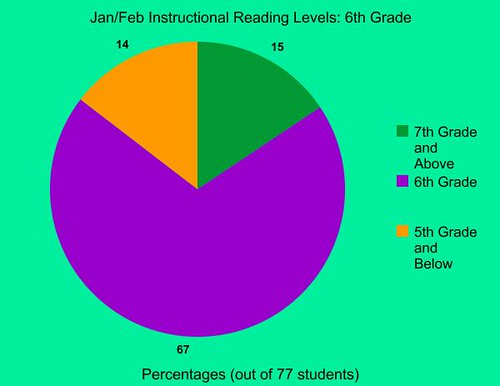
We are in our second year of conducting Fountas & Pinnell Benchmark Reading Assessments as part of a Literacy Initiative. While most teachers have a class of about 20 students to assess, I teach 77 students. I’ve been keeping track of the time I have had to spend on average for each assessment because the F/P folks say you should be able to winnow it down to about 20 minutes per student, once you know the system and have a good baseline for beginning (based on the assessment from the prior year).
If you are unfamiliar with Fountas & Pinnell Benchmark:
- There is a box of levels books
- Each level has both fiction and non-fiction text
- A student reads aloud a portion and then read the rest, silently
- The teacher marks for accuracy during read-aloud
- A discussion follows around comprehension related to information from the book, about the book and beyond the book (inference)
- You find an independent reading level, an instructional reading level and a hard reading level
But I am still finding it takes about 40 minutes per student. And even when I received some help from one our most experienced reading assessment specialists in our school, she was able to assess just four students in three hours time. So I know it is not just me. The silent reading of the upper level texts takes some time for kids, and you can’t rush them. You just have to wait them out.
A little calculation here: 77 students x 40 minutes = 3080 minutes, or a little over 51 hours of reading assessment testing. For me and my students. That means time I am not in the classroom, either, since although F/P folks say you can set up in the back of the classroom while the other students are working independently, that doesn’t work for older students. The readers become very self-conscious and the rest of the students try to listen in, ruining the element of unknown text.
Yesterday, I finally finished my last student (and I can say this, with all the irony you can read into it, given my online connections: I am sick and tired of hearing about the Internet, which is the topic of one of the higher level books in the assessment. I am also a bit weary of tsunamis, and living through the Blitz, and many of the other fictional stories in the set.)
So, is this data collection valuable?
Yes, definitely. Not only am I getting a much deeper glance into the individual reader, I am seeing the bigger picture based on the data collection (which I am collating with other data points, such as our state’s standardized testing results). If you look at the graph above, you can see that most of my students are solidly in the right instructional level. I now have a subset of struggling readers and, just as important, a group of readers that need more challenges.
Yesterday, for example, I had two readers who were like mirror opposites of each other. One of them read fluently, with almost no mistakes or errors, but then could barely answer any of the comprehension questions. The other stumbled as they read, made many errors, but then soared through the comprehension questions, for the most part. Which is the stronger reader? It depends, right? But I now have a much clearer picture of them as readers, thanks to the assessment.
I also have a clearer picture now of which students are struggling in sixth grade. Of course, I already knew much of that, based on work in class and discussions with colleagues, but here, the data fine-tunes those insights and should give me specific areas that I can work on with those students in the lower brackets of reading levels. (We’re still in training on how to interpret all of the errors in the system, however. That work will lead to development of intervention for us in the upper grades; reading intervention programs are now confined to the lower grades)
And, as we move farther into the year, particularly around independent reading, I can have a much better informed say in what level of books they should be choosing, based on the Instructional Levels. I have a basis for saying “you know, that book looks a little too easy for you” or “that book may be a bit hard, but give it a try and see how you do.”
The downsides of all this, however, is that during the assessments, I am not in the classroom during those dozens of hours of testing (although I grab students during non-class times and I have had substitutes and fellow educators fill in, and two colleagues helped with some of the assessments), and so the pace of learning slows during these cycles (We’re supposed to do it again in June) and unfortunately, there is no extension of the F/P reading system in the regional middle school where my students head next year. Last year, they told me they didn’t even want to see the data I had collected (that still irks me).
But yesterday, in the hallway, our principal stopped me and said that may be changing. The Literacy Initiative and its professional development components are now extending up through eighth grade (as opposed to stopping with us here in sixth grade).
So, there is some hope.
Peace (in the data),
Kevin
We also use the F/P assessment. I have a reading background and it still takes me 40 minutes. I am glad that I am not the only one. I do agree though that the information is useful although time consuming!
Thanks
Actually, I’m glad I’m not the only one, too, but I can’t figure out how to make it less time. I can’t rush them and to be honest, I already skimp a bit on the independent level side of things in order to focus more on instructional.
Kevin
Hey Kevin,
Thanks so much for sharing this. I can only imagine how much time it takes to conduct all of these assessments. We have nothing in place to assess the reading levels of students at my school, and while I’m sure I would bemoan the time and planning that it would take to conduct it, being able to focus my teaching to meet students’ needs would be SO wonderful.
I’ve heard some buzz about potentially getting some sort of computer-based system to give us a starting point – any thoughts on that? I’ve worked with it some, and it might take a little less time, but I still feel like some hybrid of the two might be the best route. Thanks again!
I’d hate to tear into something I don’t quite know, but the computer reading systems that I have come across have been less than stellar (and don’t be me started on Accelerated Reading and what that has done to the readers I get here in sixth grade around comprehension and critical thinking).
One of the things I like about F/P is that I am one-to-one, alone, and in conversations with the students around what the have read — including the inferential and critical thinking skills.
Maybe a hybrid would work … not sure
Kevin
So glad to hear you express briefly your thoughts on Accelerated Reader. My district uses this program, so I am required to participate, but it definitely does not drive my assessment. I do use benchmarks and data from those to plan my teaching.
Hey Kevin,
I have many of the same thoughts about F/P assessments. They’re valuable yet I always feel like they take so much time away from my small group instruction, which is where the assessment data is most useful in the first place. Our district requires that the tests be done 3 times a year, and hiring substitutes to support these requirements has become increasingly challenging and rare. Here are some strategies I use to get the information I need from the tests and get back to small group instruction ASAP:
1. Test 2 students at once. Student 1 starts by reading aloud to me, when they get to the silent reading part they move aside and student 2 reads aloud to me. When student 2 finishes reading aloud, they move aside to silent read while student 1 returns to answer questions. It gets intense and requires me to have all of the forms I’m using organized, but is a huge time saver.
2. I focus on instructional reading levels. Independent reading levels are usually a little lower but in the same general area. There are other ways for students to determine whether an independent reading selection is just right or not. I use lexiles, five-finger rule, and teach other self-monitoring strategies.
3. I’m not sure if this will work for your class, but I have a reading day. Students come to school in comfortable clothing, bring their favorite books and magazines, and spend most of the day reading independently while I test F/P levels. This only works if your class generally loves to read, as mine does this year.
You’re definitely not alone in getting tired of the same stories over and over. I know all I want to know about amazing animal adaptations and wolf howls. Also, I don’t know a student in Minnesota who can’t nail every question in the fishing book, most without even having to read the book.
Thanks
These are great points.
We tried the two-at-once, and it didn’t work for us.
Like you, I think the instructional level should be the focus, but we are required right now to shoot for all three.
We shifted from our intent of three times per year to twice per year. I still don’t know what June will look like.
Yes, we do a lot of quiet reading and I tried to do much of the assessment on “low sub plan” days.
Your last point does bring up the background knowledge issue — for example, our sixth graders just did a unit on earthquakes, so we tried to avoid that book, as best as we could. When we couldn’t, well, the kids nailed it. That was all background knowledge.
I appreciated the comments.
Kevin