More info: https://www.internationaldotday.org/
Peace (and making marks),
Kevin
(This is for the Slice of Life, hosted by Two Writing Teachers. We write on Tuesdays about the small moments in the larger perspective and then all through March — every single day … You write, too.)
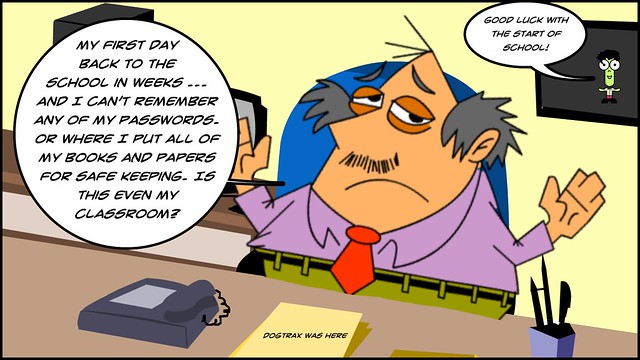
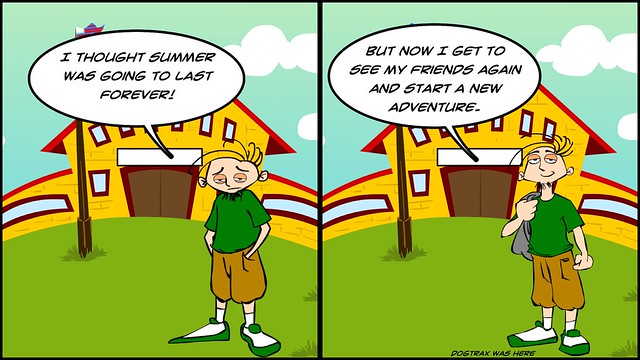
Today, we go back for the new school year with staff. Tomorrow, the kids return, and then we’re off to the races. It seemed like a time to try my hand at some “start of the year” comics.


Peace (in panels),
Kevin
As we near the end of this school year, I have asked my sixth grade students to “grade” me on a variety of topics, giving me some anonymous input and information about how they perceived me as a teacher of writing, reading and technology.
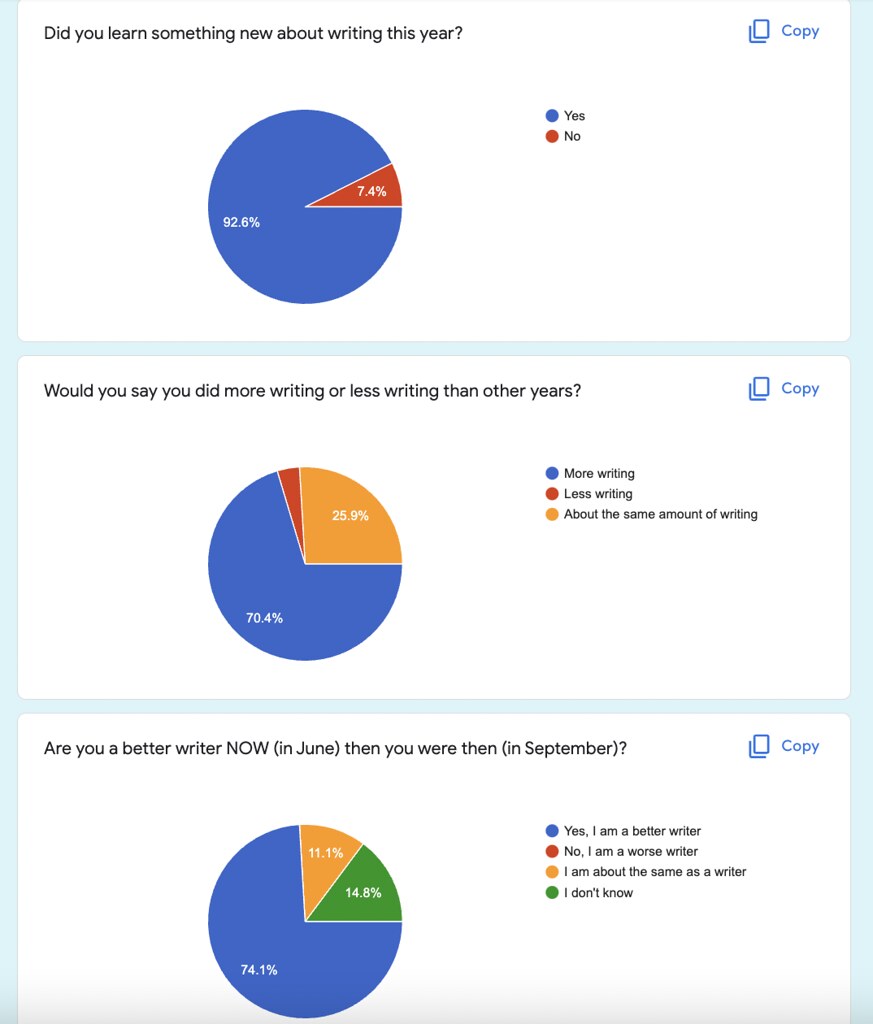
The first set of questions center on writing, and I wondered if they identified growth in themselves as writers, and if our regular writing activities were central to how they thought about our ELA class this year. (see chart above)
I was pleased to see that most students thought they emerged as a better writing, and that they learned new skills and new genres this year in the field of writing. My aim is always to support them as writers and then challenge them in new directions as well.
Other parts of the survey connect to reading, technology and my role as a teacher. I left a space for them to write me a comment, if they wanted, and it warmed my heart to read what they wrote. A few stood out.
When I first came to 6th grade ELA was my least liked class but, now after this year I have come enjoy writing. Thank you for all you have done for me, I enjoyed my time in your class and I’m sure that many people in the future will enjoy your class too. I think one thing you can do better as a teacher would be to allow more free write (story writing) in the year and also sometimes have a share time for people to share their work. Over-all I enjoyed being in your class. Thank you for being a great teacher.
Overall ELA class was my favorite class this year. I like when we were able to to free write in our notebook. ELA class entertaining and fun the majority of the time. Your positive mindset help with the overall vibe in class this year. I think you should keep doing writing prompts and let students explore with writing more on their own. Thanks for a great year.This ELA class was the best one so far, keep it up Mr. Hodgson. I would not change anything
Peace (in thoughts and reflection),
Kevin
(This is for the Slice of Life challenge, hosted by Two Writing Teachers. We write on Tuesdays about the small moments in the larger perspective and then all through March — every single day … You write, too.)
I’m watching her talk;
the first time in the classroom
with her mask, fully off,
and there’s something wondrous
about such a moment
of clarity that comes coupled,
uncomfortably, with concern
Peace (first day with no mask requirement),
Kevin
 (This is for the Slice of Life challenge, hosted by Two Writing Teachers. We write on Tuesdays about the small moments in the larger perspective and then all through March — every single day … You write, too.)
Our School Committee members voted the other night to lift our mask mandate at our school when we return from February break next week. They had sent out surveys to teachers and parents, but not students. That got me irritated, as they seem to consistently avoid asking students what they think, so I revamped their parent survey and had my sixth graders voice their opinions. I sent it off to the School Committee before their meeting, and to its credit, the chairman shared the students survey in the meeting before any other results.
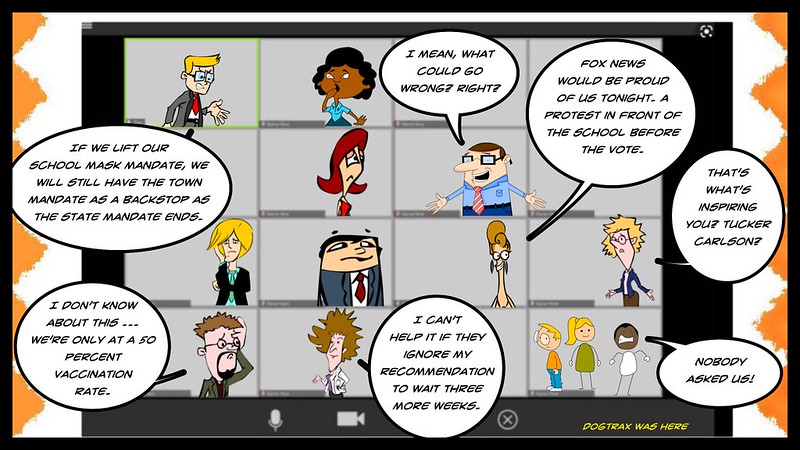
The School Committee ignored advice from the health officials on the timing of lifting the mask mandate, but the discussions – even in the public hearing section – were civil and thoughtful, a rarity in today’s meetings (even in our town).
I wasn’t surprised to see my students voting in the majority to lift the mask mandate, as this is a fairly conservative community and students are generally just tired of wearing masks, but I was curious and a little concerned about the second question, asking them whether they will still wear masks even if the mandate was dropped.

A full third of the students who took the survey indicated they weren’t sure, although I know many have thought about it and talked about it, and as we approach this moment of shift in masking, I know there are going to be some students who want to wear a mask for protection, and are allowed to, but may not, due to pressure from friends, either overt or not.
I don’t know how family decisions will play into all of this either, since we are not going to be policing which students have been given permission to wear masks and which have not.
As a teaching team, we’re already mulling on ways to make all students comfortable in whatever decision they make, and to accept and support any decision anyone else makes, as well. We’ve had discussions about Morning Meeting as a time to reinforce talk of respecting opinions in a larger community and we’ve talked about us, teachers, wearing masks, even if we wouldn’t otherwise, as an act of solidarity to any students feeling on the edge or uncertain. I am sure the administration has information going home, as well.
It seems as if every step of the way in this Pandemic, we keep having to learn new ways to navigate forward, and strategies to help our students do the same.
Peace (in choice),
Kevin
(This is for the Slice of Life challenge, hosted by Two Writing Teachers. We write on Tuesdays about the small moments in the larger perspective … or is that the larger perspective in the smaller moments? You write, too.)
It’s not that I don’t ever see my students without masks — snack, lunch, walks outside, etc. — but with our state now lifting mask requirements for schools at the end of the month and my school district likely this week to follow suit at the local level (although what that will look like, we don’t quite know), I’m trying to remember what it was like to see all those young faces, to see all the smiles, to notice the full looks and emotional reactions on faces, as it once was, all the time.
In class discussions, there’s a wide range of reactions by students to this possible news of ending the mask mandate. Some can’t wait. Others seem nervous. When something lasts two years, it becomes a sort of reality, the way things are. Masks have protected, hidden and defined us in many ways.
Maybe we can step forward, carefully and guided by science, into a new reality yet again (same as the old reality) and as a teacher, I will be able to better read the room again, the way things might yet still be.
Peace (thinking forward),
Kevin
PS — the downside to loosening masks? Litter. This was my morning poem today after noticing our playground area yesterday:
Beneath this snow
and ice pack of winter,
abandoned masks
litter this place –It’s confetti, like loose parts
and colored fabric bits,
so we bide our time
to gather on itThe ripped strings
as abandoned seeds,
but nothing here’s rooted
or anchored by trees
(This is for the Slice of Life challenge, hosted by Two Writing Teachers. We write on Tuesdays about the small moments in the larger perspective … or is that the larger perspective in the smaller moments? You write, too.)
I looked around the classroom as the bell range and realized: We’re all here.
Every single one of my students was in the building, at their seats, chatting and working as the first day of the week began. Full house. So unusual these days between Covid absences, regular sick absences and more. So much so that I completely forgot to do our online attendance, and got a call from the office, wondering if anyone was absent.
“Nobody!” I shouted into the phone with a smile. “Everyone’s here.”
It’s been weeks since we, as a class, were whole like this, and when I mentioned my observation during our Morning Meeting, they all looked around, as if noticing the room anew and seeing themselves as a complete package — 21 students, one paraprofessional, and one classroom teacher — for the first time in weeks.
It was.
Let’s hope today remains full, too.
Peace (looking about),
Kevin
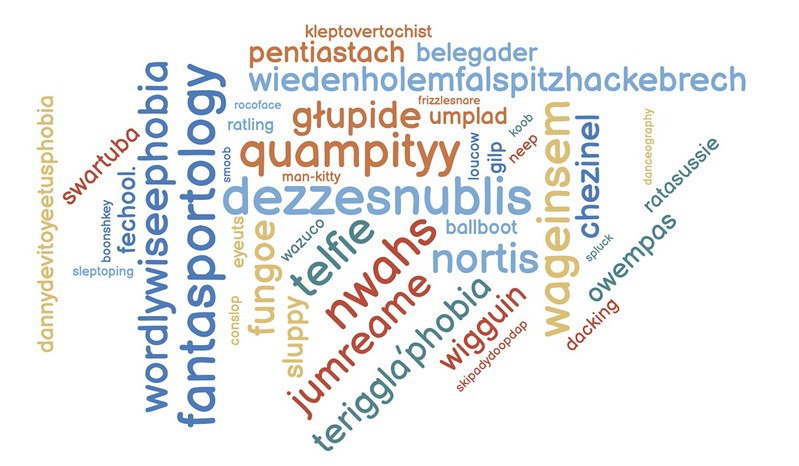 This is a collection of some of the invented words my sixth graders created as part of our Word Origins unit. The words were then donated to our Crazy Collaborative Dictionary project, which has been gathering words from every sixth grader since 2005 and has more than 1,000 words and voices (each student now podcasts their word and definition, too).
Peace (in the book of words),
Kevin
 We’re nearing the end of our Video Game Design project and so, my task as a teacher was to play their stories which are video games, and that meant playing nearly 60 games.
Many were very interesting — with cool design features and narrative frames set into levels in meaningful ways. Others were lacking enough story, which was a focus every single day in class as they worked.
I assess the projects along two strands — the design of the game (playability, choices around challenges and tools, flow of the game, etc.) and story (consistency of narrative, the reader is a player in a story, proofreading/editing, etc.)
Overall, I was impressed by how they were able to juggle the Hero’s Journey framework of story with the design of video games inside Gamestar Mechanic. And all of my students were highly engaged in this project, from start to finish.
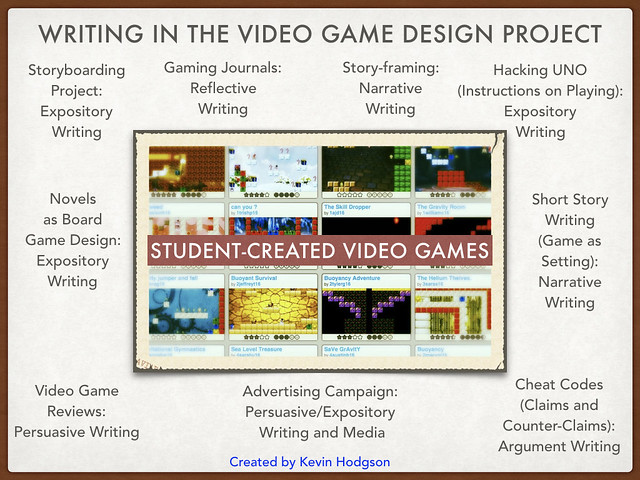
And as always, we did a lot of writing beyond the game design itself. I made this a few years back for a presentation and most of these writing assignments are still central to this particular project.
Peace (leveling up),
Kevin
