Am I the King of Similes?

I spend the month of April writing poems each day over at Bud Hunt’s blog. There were some cool ones and some throw-aways. That’s writing under pressure for you. I gathered up the 30 poems and dumped them into Wordle, just to see if there any emerging themes from what I was writing.

Here’s what I noticed: I used the word “like” a lot. Like, too much. Like, I must be overusing similes in my poems. And I think when I do write poems, I do use similes and metaphors a bit too much, because I am trying to move the poem from something concrete to something abstract, and that’s difficult to do without those comparisons. I don’t intend to abandon the use of these literary devices, but I like how the Wordle made that visible.

Also, it’s neat that “music” and “mind” were part of a lot of the poems. I’m not sure what to make of the word “even” as the most prevalent word in the batch of poems. It doesn’t seem to have much meaning for me.

Here was the last poem that I wrote with Bud to end April’s National Poetry Month:

I’m forever letting my tongue dance
over phrases
and even while the silent world ignores me,
I continue on with my “inside” compositions,
scribbling alone in the dark corner of my mind,
turning ideas over like compost as I wait
for the flowers to bloom.
I’ve come to the realization that not everyone hears
the words as I hear them,
nor do they dance to the same rhythm,
and so,
what begins as a conversation among many
often ends as a monologue of one.

Peace (in the poems),
Kevin

Emily Dickinson Lives!

Yesterday, thanks to the work of our school librarian, we had a special poetic visitor arriving from the Great Beyond. An actress who performs as Emily Dickinson (who lived in nearby Amherst) spent time with my students yesterday morning, talking and acting as if she were Emily Dickinson. She talked of her life and of her writing, and while it is hard to keep sixth graders in Spring in their chairs for (for them) an obscure poet, they were mostly attentive.

My student teacher is doing her unit around poetry (ack, I really miss teaching poetry this year), so the timing was right. As the librarian and I agreed, our kids need a variety of styles of performances (we had Mordicai Gerstein not too long ago and he was drawing, and laughing, and energetic with them).

And plus, who better to bring back from the dead than Emily Dickinson?

I’ve always like this poem of hers:

AFTER a hundred years
Nobody knows the place,—
Agony, that enacted there,
Motionless as peace.
Weeds triumphant ranged, 5
Strangers strolled and spelled
At the lone orthography
Of the elder dead.
Winds of summer fields
Recollect the way,— 10
Instinct picking up the key
Dropped by memory.

Peace (in the poems),
Kevin

What the Poem in your Pocket?

Poem In Your  Pocket Day

Today is Poem in Your Pocket Day, when you are invited to print out or write out a favorite poem and keep it close to you throughout the day. I chose a poem called, eh, “Pockets” by Howard Nemerov.

It’s a new poem to me, but I like the use of pockets as a metaphor here, seen as lonely collectors of stuff  — but sort of a “theives’ kitchen” of things that bounce around all day — and which ends with the cool line of,  “What is a pocket but a hole?”

What poem will you carry around with you today?

Peace (in the poems),
Kevin

Glogging Some Multimedia Poetry

As readers of this space know, I have been writing poems every day over at Bud Hunt’s blog, where Bud has been posting images to inspire writing. We’re almost at the end (which is fine — I’m feeling a little poetry burnout right now) but I wanted to find some way to collect some of the poems together.

I decided to use Glogster because I could easily add the video poem I did, as well as upload a few podcasts from the month of poetry. I tried to find a good design, and I worry that the page is a bit busy (always an issue with Glogster), but I made this as  sort of “Thank You” card to Bud for inspiring me to write this month. I was always glad when others joined along, although I wish more folks would do it.

I also like that this glog is part of my classroom glog, so my students have a chance to read some of my poetry and see some of the multimedia work, too. It’s another way of sharing and showing.

Here is a direct link to my poetry glog, which I am entitling: “Inspired by Images.”

Peace (in the poems),
Kevin

Avant-Garde Composing

When I was an undergraduate — majoring in English, minoring in music — I had a professor who seemed very much out of sync with our small state college surroundings. Dr. Peacock seemed to have come from the fabric of New York City’s avante-garde composition scene and what he was doing at our college was never quite clear.

But it was with Dr. Peacock that I first learned about how a composer could push the boundaries of the norm when it came to creating music. He taught me about using synthesizers (we had this old monster of a keyboard that you had to program to make work — it was like hacking into a computer); how to cut “tape” of musical recordings and re-fashion those pieces into something new (the forerunner of remixing); and how to create atonal pieces of music. Oh, yeah, and how to open up the top of a grand piano and tinker with the insides to create strange, beautiful sounds from the percussion elements of the Grand. (This did not go over well with his teaching colleagues and more than once, I watched him argue with another teacher about why his students had their hands in the strings of the Grand and why were placing objects along the percussive hammers.)

He was all about pushing the boundaries of music. And he was all about the “doing” as much as the theory behind what was being done. I felt like an explorer moving into unknown terrain most of the time, and thoroughly enjoyed the experience.

I was reminded of him yesterday as I followed  a link from Larry Ferlazzo’s blog to a site by Jason Freeman called Piano Etudes, where Freeman has worked to create an interactive site in which the viewer can use fragments of his piano pieces to refashion them into something new. It’s a very visual experience, as Freeman has mapped out how the pieces of a composition might intersection, and you grab elements and pull them together. Then, you can add your piece to the gallery at his site, download the music as an MP3 file and/or get a PDF of the score (see the image above, which comes from the PDF).

Freeman writes:

Inspired by the tradition of open-form musical scores, I composed each of these four piano etudes as a collection of short musical fragments with links to connect them. In performance, the pianist must use those links to jump from fragment to fragment, creating her own unique version of the composition. The pianist, though, should not have all the fun. So I also developed this web site, where you can create your own version of each etude, download it as an audio file or a printable score, and share it with others.

I plunged right in, and created a version of Freeman’s “Reading  Poem,” which I called “Writing a Poem by Starlight.” I downloaded the mp3 file, and then write a poem inspired by the music, which has a lot of space and open air to it. Then, I recorded the poem in Audacity, with the Freeman-derivative score as the background music.

Want to hear it?

Listen to Writing a Poem by Starlight

Here is the poem:

Writing poetry by starlight,
I touch the keys
so that I may coax
the darkness
to play a duet with light,
and shimmer until morning
comes …

Give it try. Write some music. Remix and create.

Peace (in the exploration),
Kevin

A Poem Podcast: Trying to Make My Writing Visible

Apple
Creative Commons License photo credit: Selma90

Many of us write in silence, with just our thoughts ringing out inside. This morning, as I was about to move into the 19th day of writing a daily poem with Bud Hunt and his image-inspiration concept (each day, Bud posts a picture and encourages us to write a poem), I thought I would try something a little different.

Before I even went to Bud’s site to see the picture of the day, I turned on my microphone and began to talk. My goal was to try to make visible my writing process with today’s poem. I did this because I have noticed how often my poems seem to have little relation to the photos that Bud shares, and yet, the photos are the spark of inspiration. And I write without stopping to reflect on what I am really doing. I go with the flow. But where does the flow come from? That’s sort of what I was after.

I realize that this podcast is a bit self-indulgent, but if you have time and interest, I would love for you to give it a listen and see what you think. I’d appreciate some feedback on this kind of on-the-spot reflection. And I wonder, is this kind of vocal writing feasible in the classroom? What if we gave out voice recorders and asked kids to talk as they wrote and edited? What would happen?

Walking Through a Poem: A Podcast Reflection

And then, here is the poem itself that I wrote that was inspired by the apple photograph that Bud shared today:

In the orchard, I climb trees
in places where the branches twist and turn
as if they are a road map to some forgotten place
and my eyes travel these roads to remember.

I swerve to avoid the humming bees,
and ignore the other travelers along the road
as I reach out my fingers to grasp the treasures
of time and space.

In the orchard, I remember the taste of memory
as sweetness and sour
and bite into life with my eyes closed,
thinking always that this moment may soon disappear.

I rest, weary, on the damp grass
and gaze up through the branches, again,
my vision zigzagging towards the blue sky above;
my world crunching in my mouth.

In the orchard, I climb trees
in places where the branches twist and turn …

Peace (in the podcast),
Kevin

Writing (digital) Poems with Bud

I continue to enjoy the poetry adventures over at Bud the Teacher’s blog. Bud posts a picture, a few words and opens up his space for poems. I get up, wondering what I might write about today. I’ve been using Vocaroo to record as podcasts, and Bill has followed my lead. The other day, Kelly responded to a poem of mine with a poem of hers, and then I responded — a poetic conversation of sorts.
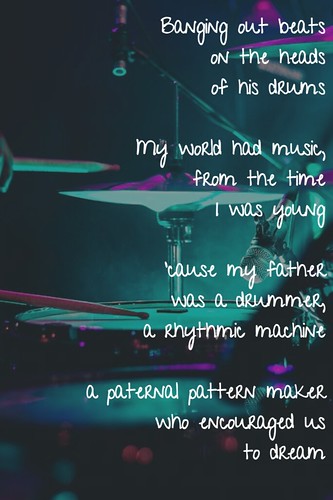
This morning, he posted an interesting picture and suggested a mixing up, which made me think of a remix of some sort, which led to wonder about elements within the photo.

So, I fashioned a short digital poem about listening to someone practicing music and wanting to join in. I made it in a few minutes with Photostory3.

Come write with us at Bud’s place. There a seat at the table for you.

Peace (in the poetry),
Kevin

Get the Poetry Flowing


I  saw this note in a Twitter feed and decided to check it out. It’s an app for iPhone or iTouch or iPad(?) called Poem Flow, and it is a pretty cool system of presenting famous poems in a flowing, visual way. The basic app is free and comes with about a dozen poems, and then they charge you for extra downloads.

But here is the beauty: if you are an educator, you get the download upgrade FOR FREE. It’s definitely worth checking it out. I had nice time reading/watching some poems last night. And I noticed that on the form that teachers have to take to get the free code, there is a question of whether you might be interested in learning more about an upcoming application that allows you to create your own poetry flows. Heck yes!

You can find Poem Flow at the Apple App Store.

Peace (in the flow),
Kevin

Being a writer in a room of writers

Last night, as part of the New England Writing Project Retreat down at University of Connecticut, a large group of us teacher-writers wandered down to an Open Mic that had been set up as part of the retreat. The room was filled with high school creative writers, undergraduate and graduate students, and us teachers in the National Writing Project. All too often, we teachers write with other teachers. It’s as isolating as being in your classroom (although the National Writing Project is a place that helps dispel that feeling). So, to be part of an Open Mic event with students reading their writing (and in one case, singing a song, and in another, performing a one-act play) was fascinating and interesting and invigorating, and my ears overflowed with amazing poems. We were all equal — writers in a room of writers.

One of the teachers with me out his poem and, looking out at the crowd of young and older faces, smiled, and said, “I thought I would be reading to a group of English teachers,” but the kids were receptive and open to all sorts of writing.

Jason, here at UConn Writing Project, helped organize the event and I appreciated this kind of mix of teachers and young writers, who were clearly as happy to have us as their audience as we were to have them. I read a poem that I wrote over at Bud the Teacher’s blog this week. The poem is still in revision  (I was scribbling on it in the seconds before I stood at the podium) but I felt like this was an audience that would accept whatever words flowed from my mouth.

Peace (in the poems),
Kevin