Archive for April, 2010

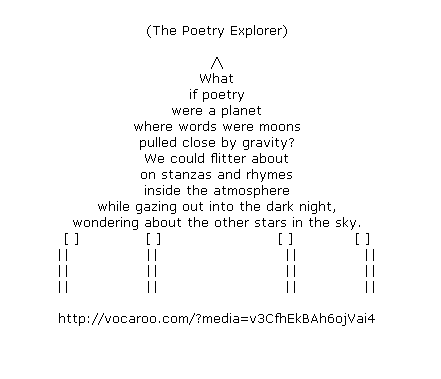
What if Poetry were a Planet …

I tried my hand at a shape poem this morning over at Bud the Teacher’s blog, where he has been generously sharing photos as inspiration for poetry this entire month (Thanks, Bud!). The image today was of a spinning galaxy, which got me thinking metaphorically, and then it made sense to try to create a spaceship out of my words.

Peace (aboard the poetry ship),
Kevin

Computers in their Pockets

At my school, if we see a cell phone, we are supposed to take it away. Then, we give it to the principal, who has to call the parents come in for it. I have to admit, I have never taken a cell phone or mobile device from a student, but I have had discussions with students about keeping it out of my view and do not use it during school.

Isn’t that odd? Here I am, trying to show a path into technology and composing for my students, and I don’t allow them to use the single most important piece of technology many of them carry around with them all day long.

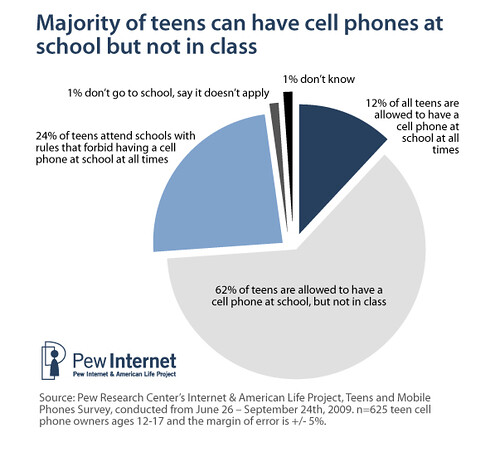
The graph above comes from a report just out from the Pew Internet & Family Life Project (these folks needs a huge round of applause for their work in making data available) around teens and their cell phones, particularly around text messaging.

Some of the findings in the report, which is entitled Teens and Mobile Phones:

  • Half of teens send 50 or more text messages a day, or 1,500 texts a month, and one in three send more than 100 texts a day, or more than 3,000 texts a month.
  • 15% of teens who are texters send more than 200 texts a day, or more than 6,000 texts a month.
  • Boys typically send and receive 30 texts a day; girls typically send and receive 80 messages per day.
  • Teen texters ages 12-13 typically send and receive 20 texts a day.
  • 14-17 year-old texters typically send and receive 60 text messages a day.
  • Older girls who text are the most active, with 14-17 year-old girls typically sending 100 or more messages a day or more than 3,000 texts a month.
  • However, while many teens are avid texters, a substantial minority are not. One-fifth of teen texters (22%) send and receive just 1-10 texts a day or 30-300 a month.

But I am fascinated by how schools are dealing with cell phones and mobile devices. Most, like mine, have antiquated notions of the “disruptions” that can be caused by the devices. Few see the mobile devices as possible tools for learning.

And that has included me, to some degree. I don’t have much experience with cell phones (mine is an old version that barely functions as a phone) but I know there is something there “there” that we should figure out. I realize there are impediments — different phones have different services and Apps; the equity and access issues; parental permissions; and more.

Still, when we think about young people writing, the cell phone has certainly become a natural slate for ideas. How do we tap that?

Peace (in the Pew),
Kevin

Day in the “Extreme” Sentence

My good friend from New Zealand, Ken — Adayinsentenceicon Blogger in Middle-Earth –is taking over as guest host for this week’s Day in a Sentence. Given the news from the world about volcanoes and such, Ken asks that we take our sentence to the extreme — really kick your reflection up a notch, if you can.

Not sure how Day in a Sentence works?

So come join us.

And as Ken would say:


Ka kite anō – Catch ya later

Peace (in the sharing),
Kevin


Making the Case for a Paradigm Shift

I found this presentation by Michelle Pacansky-Brock via a post in my RSS and thought it was interesting. I like how she gives some specific examples towards the end.

Peace (in the hybrid world),
Kevin

A Poem Podcast: Trying to Make My Writing Visible

Apple
Creative Commons License photo credit: Selma90

Many of us write in silence, with just our thoughts ringing out inside. This morning, as I was about to move into the 19th day of writing a daily poem with Bud Hunt and his image-inspiration concept (each day, Bud posts a picture and encourages us to write a poem), I thought I would try something a little different.

Before I even went to Bud’s site to see the picture of the day, I turned on my microphone and began to talk. My goal was to try to make visible my writing process with today’s poem. I did this because I have noticed how often my poems seem to have little relation to the photos that Bud shares, and yet, the photos are the spark of inspiration. And I write without stopping to reflect on what I am really doing. I go with the flow. But where does the flow come from? That’s sort of what I was after.

I realize that this podcast is a bit self-indulgent, but if you have time and interest, I would love for you to give it a listen and see what you think. I’d appreciate some feedback on this kind of on-the-spot reflection. And I wonder, is this kind of vocal writing feasible in the classroom? What if we gave out voice recorders and asked kids to talk as they wrote and edited? What would happen?

Walking Through a Poem: A Podcast Reflection

And then, here is the poem itself that I wrote that was inspired by the apple photograph that Bud shared today:

In the orchard, I climb trees
in places where the branches twist and turn
as if they are a road map to some forgotten place
and my eyes travel these roads to remember.

I swerve to avoid the humming bees,
and ignore the other travelers along the road
as I reach out my fingers to grasp the treasures
of time and space.

In the orchard, I remember the taste of memory
as sweetness and sour
and bite into life with my eyes closed,
thinking always that this moment may soon disappear.

I rest, weary, on the damp grass
and gaze up through the branches, again,
my vision zigzagging towards the blue sky above;
my world crunching in my mouth.

In the orchard, I climb trees
in places where the branches twist and turn …

Peace (in the podcast),
Kevin

May 1 is Free Comic Book Day

My sons and I look forward to Free Comic Book Day each year. On May 1, your local comic book (and some book stores) will be passing out handfuls of free comic books. The comics are not collectibles, of course, and most are designed to give you a hook into a character or story. But still: free comics. And check out the image  above, as world renowned comic illustrator (from Mad Magazine and the Groo series) Sergio Aragones has fashioned a nifty image for Free Comic Book T-Shirts this year.

I often grab a bunch to bring to my classroom, and I have used my stack periodically to talk about literary terms like onomatopoeia and use of dialogue, and emanata  (use of images to portray ideas).

At the Free Comic Book Day website, you can even use the store locator to find a store that is participating near you.

Peace (on the funny pages),
Kevin

An Essay Brainstorm: If I Were in Charge …

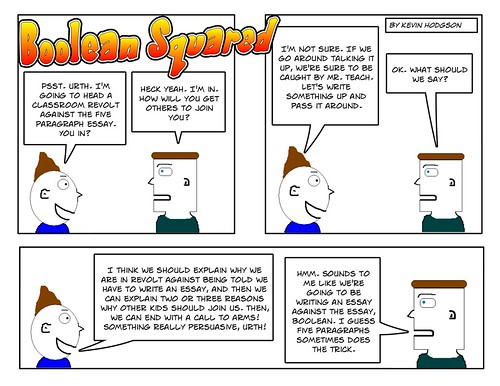
Last week, I had my students working on the dreaded Five-Paragraph Essay Project, which is a line item on our new Standards-based Progress Reports and so I must have them working in this genre. I am not a huge fan of the Five-Paragraph Essay — I find it very restricting and when in life will they ever write like this, other than in school? (I once did a series of Boolean Squared comics against the essay). But, I recognize that the essay genre does allow us to teach format, writing with constraints, and also, most importantly, organization of ideas.

My students worked on essays around the theme of improving their own community. I had them imagine that they were put in charge of the town. What needs improvement? How would you make that change? We talked about the way our town makes decisions, the form of government (Select Board and Town Meeting), and how the community is involved in making changes.

We then brainstormed possible ideas that could form the body of their essays, and I found it a wealth of great ideas.

  • More sidewalks for pedestrians
  • Build more energy-efficient buildings
  • Develop more enertainment/commercial areas
  • Street lights on side-streets
  • More crosswalks
  • Better public works (snow plow, paved roads, etc.)
  • Need bike paths
  • Preserve open space
  • Protect local animal habitats
  • Need animal shelter
  • Small medical center/hospital (emergency care)
  • Public transportation
  • New equipment/expanded service for fire and police
  • Sports equipment
  • More areas for housing/real estate (and new roads)
  • Flower gardens/community gardens
  • More recreational areas (Swimming, athletics, etc.)
  • Public space (like Look Park or Stanley Park)
  • Bike Path
  • Beautification project
  • Slow down building construction
  • Support police (new police station)
  • Medical center/hospital
  • Small airport
  • New technology for the schools
  • Bigger public park
  • Less gas stations
  • More tourist attractions
  • Combine Southampton with Easthampton/Westhampton

A few students asked if they could send their essays to Town Hall when they were done, and of course, I said “Absolutely!” and I meant it. The more authentic the audience is, the better the motivation for writing.

Peace (in the form),

Kevin

When Students Make Search Stories


The other day, I wrote about the Google Search Story Creator, which is a pretty nifty digital story generator that creates short videos based on queries that you put into Google (and, the site is yet another reason for us to use Google, meaning more eyeballs on their advertisements).

Yesterday, as we wound down the week (and a day after an exhausting Quidditch Tournament — my class did not win, but they came together nicely as a team), I decided to use class time for catch-up and play. My students are finishing an essay project and those that were done, I brought to the Google Search Story site.

First, though, we talked about how you might use it to tell a story and not just plug in random search terms. I told them to invent a character who is behind a computer. What is going on? What does the viewer need to know, and just as important, what does the viewer need to figure out on their own?

And I put this up on our whiteboard:

  • You have only seven lines of search, so narrow your focus;
  • Develop your search story around one theme/one idea;
  • Don’t just create a story of random search entries — really try to tell a story — make the reader/viewer figure out the story (think of it like a puzzle that the reader/viewer has put together)
  • Match the music with the story — sad music should not go with a happy story.

I then created a class YouTube account for those stories that seemed to show good thoughtfulness, and we have been sharing the more than 20 video stories over at our classroom blog site. The use of a YouTube playlist has been most helpful because you can embed the whole playlist. (What you see above here is a modified playlist with the one story that I did as a sample — An Apple for the Teacher — and then a handful of student stories. I personally like the iPod story. She “got it” when it came to using the site, I think.)

Peace (in the story),
Kevin